Complete Guide
Mexican Train Rules: How to Play, Score, and Win
Learn how to play Mexican Train dominoes with simple step-by-step rules, setup instructions, scoring, doubles, common house rules, and beginner tips. Whether you are new to the game or just need a quick refresher, this guide covers everything you need to start playing.
Quick Answer: What Is Mexican Train?
Mexican Train is a domino game where each player builds a personal train while also being able to play on a shared public train called the Mexican Train. The goal is to play all of your dominoes and finish with the lowest total score after all rounds.
Mexican Train Rules Cheat Sheet
- Match the open end of the train with the same number.
- On most turns, play one domino if you can.
- You may play on your own train, the Mexican Train, or a marked public train.
- If you cannot play, draw one domino from the boneyard.
- If you still cannot play, mark your train public.
- Doubles are placed sideways and must be covered.
- If a double is left open, the next players must try to cover it before normal play resumes.
- The round ends when a player goes out or nobody can play and the boneyard is empty.
- The player with the lowest total score after all rounds wins.
🎯 Objective
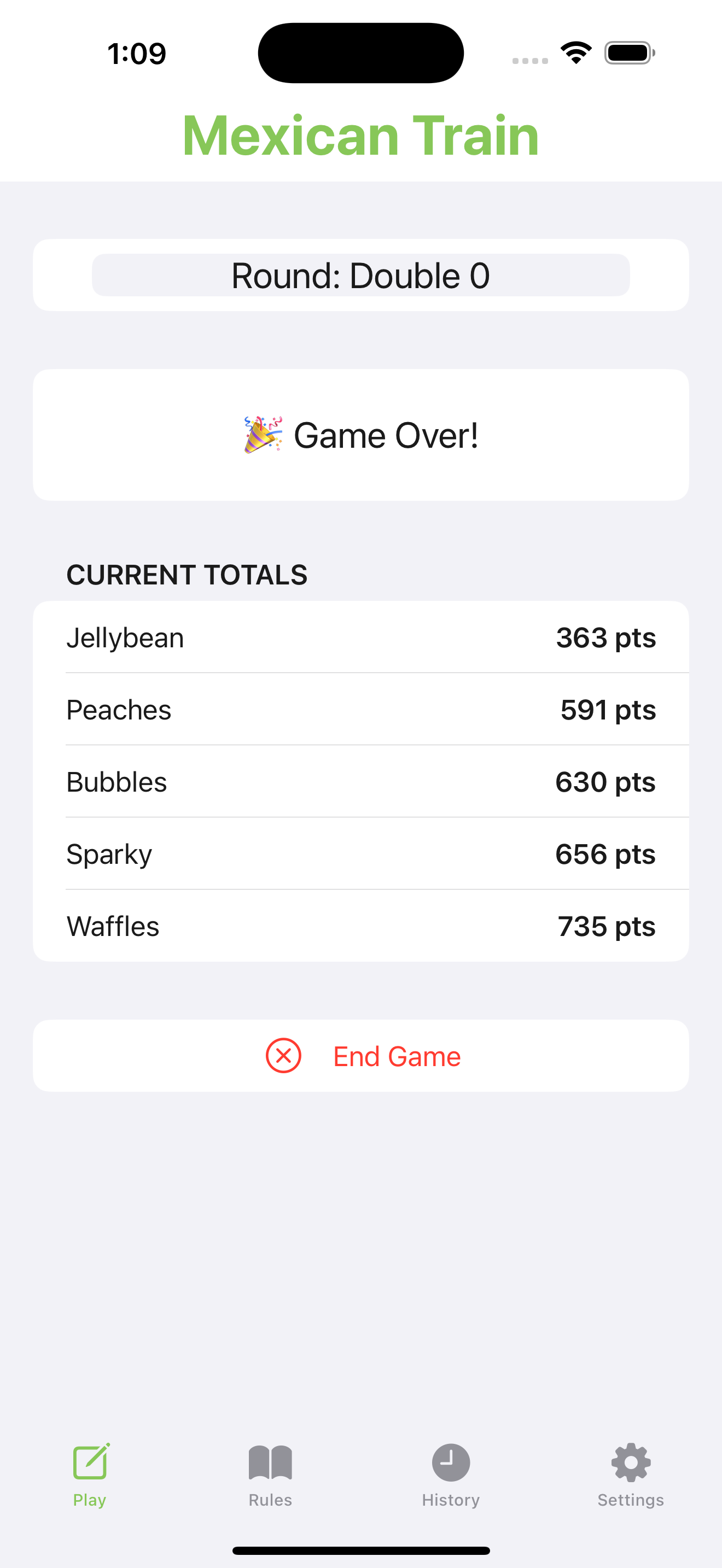
The goal of Mexican Train is to get rid of all of your dominoes as efficiently as possible. At the end of each round, any dominoes left in your hand count against you. After all rounds are played, the player with the lowest cumulative score wins.
🧩 What You Need to Play Mexican Train
- A Double-12 domino set is the most common choice for Mexican Train.
- A train hub and markers are helpful, but not required.
- If you do not have train markers, coins or small objects work fine.
- You can also play with a Double-9 set for fewer players or a shorter game.
🎲 1. Setup
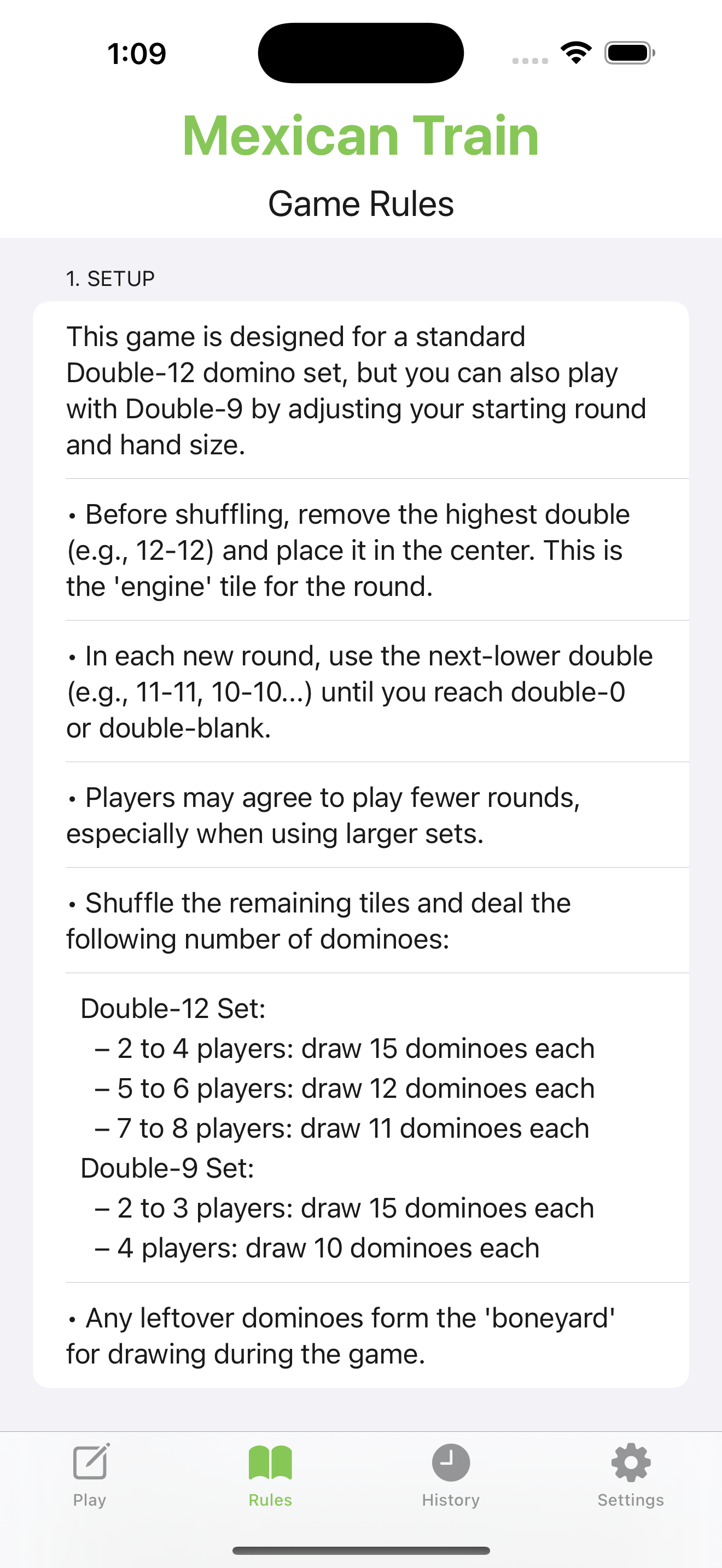
This guide assumes a standard Double-12 domino set, though the game also works with Double-9 by adjusting the number of rounds and the number of tiles dealt.
- Shuffle all dominoes face down.
- Take out the starting double for the round and place it in the center. This is the engine.
- In later rounds, use the next lower double each time: 12-12, then 11-11, then 10-10, and so on until the final round.
- Each player builds a personal train from the center outward.
- One shared line becomes the Mexican Train.
| Set |
Players |
Dominoes Each |
| Double-12 |
2 to 4 |
15 |
| Double-12 |
5 to 6 |
12 |
| Double-12 |
7 to 8 |
11 |
| Double-9 |
2 to 3 |
15 |
| Double-9 |
4 |
10 |
Any leftover dominoes form the boneyard, which players draw from when they cannot make a play.
🚦 2. Starting the Round
Some groups begin by placing the engine tile in the center automatically for the round. Other groups use a “find the starting double” method where players draw or reveal tiles until someone has the required opening double. Both approaches are common house-rule variations.
Once the engine is in the center, each player begins building a train that starts with a domino matching that engine number.
🪜 3. How to Play Mexican Train Step by Step
-
Check your playable options.
On your turn, look for a domino that matches the open end of an eligible train.
-
Choose where to play.
You may play on:
- Your own train
- The Mexican Train
- Another player’s train, but only if it is marked public
-
Play one domino.
On a normal turn, you place one domino and your turn ends.
-
Draw if you cannot play.
If you have no legal move, draw one domino from the boneyard.
-
Play the drawn domino if possible.
If the tile you draw can be played, play it immediately.
-
Mark your train if you still cannot play.
If the drawn domino also cannot be played, place your marker on your train. This makes your train public until you successfully play on it again.
🚂 4. Understanding the Trains
Your Personal Train
Your train is private unless it becomes marked because you could not play.
The Mexican Train
The Mexican Train is public and any player may use it once it has been started.
Marked Public Trains
If another player’s train is marked, it is open for other players to use until that player plays on it again.
✳️ 5. Doubles Rules
- Doubles are played sideways or perpendicular so they stand out clearly.
- When you play a double, it must be covered with a matching domino.
- If you can cover your own double immediately, do so.
- If you cannot cover it, the obligation passes to the next player and continues clockwise until someone covers it.
- Many groups pause normal play until the open double is satisfied.
Example
If the open end of a train is a 7 and you play a 7-7 double, the next required play must also match 7 in order to cover that double.
🪙 6. What Happens If You Cannot Play?
- Draw one tile from the boneyard.
- If you can play it, place it immediately.
- If you still cannot play, mark your train public and end your turn.
- If the boneyard is empty and you still cannot play, simply pass and keep your train marked if required.
🚨 7. Special Situations and Common House Rules
- No one has the starting double: many groups draw until someone finds it.
- First turn rules vary: some groups allow players to play multiple dominoes on their first turn, while others allow only one tile per turn from the start.
- Open doubles vary: some groups require the next player to cover the double no matter what, while others follow slightly different double-handling rules.
- Shorter games: some groups start at a lower double instead of playing every round.
Mexican Train is famous for house rules, so it is smart to agree on setup, first-turn rules, and double rules before the first domino hits the table. Saves friendships and folding tables.
🏁 8. How a Round Ends
- A round ends when a player plays their last domino, or
- No player can make a move and the boneyard is empty.
🧮 9. Scoring in Mexican Train
- The player who goes out scores 0 for the round.
- All other players count the total pips on the dominoes left in their hands.
- That total is added to each player’s running score.
- After the last round, the lowest total score wins.
🏆 10. Winning the Game
Mexican Train is usually played over multiple rounds, descending from the highest double to the lowest double in the set. When all rounds are complete, the player with the lowest cumulative score is the winner.
💡 11. Beginner Tips for Mexican Train
- Try to get rid of high-value dominoes early.
- Do not ignore the Mexican Train; it often gives you an extra escape route.
- Watch which numbers other players seem to avoid.
- Be careful with doubles unless you can cover them.
- If your train is public, prioritize closing it when you can.
🔄 12. Popular Mexican Train Variations
- Play with Double-9 for fewer players or shorter games.
- Allow multiple dominoes on the opening turn only.
- Use partnerships in larger groups.
- Play a shortened set of rounds, such as starting at 9 instead of 12.
- Use more aggressive doubles rules similar to Chicken Foot style play.
❓ Mexican Train Rules FAQ
Can you play on another player’s train in Mexican Train?
Yes, but only if that train is marked public because the player could not make a play on a previous turn.
Can you always play on the Mexican Train?
Yes. Once the Mexican Train has been started, it is public and available to all players.
What happens when you cannot play in Mexican Train?
You draw one domino from the boneyard. If you still cannot play, your train becomes public.
What happens if the boneyard is empty?
If the boneyard is empty and you cannot play, you pass. If no one can play, the round ends and everyone counts their remaining pips.
What happens if you play a double?
A double must be covered with another matching domino. If it is left open, players usually must satisfy that double before normal play continues.
How many dominoes do you start with in Mexican Train?
That depends on the domino set size and the number of players. A Double-12 set usually uses 15 dominoes each for 2 to 4 players.
How do you win Mexican Train?
You win by having the lowest total score after all rounds are completed.
Are there official Mexican Train rules?
There are many common rules, but house rules are extremely common. It is best to agree on setup, first-turn play, and doubles before starting.
History of Mexican Train Dominoes
Mexican Train is a modern domino game that grew in popularity through family game nights, retirement communities, clubs, and casual home play. It blends traditional domino matching with a shared public train, which makes it easy for new players to learn while still offering strategy for experienced players.
Although the exact origin is not perfectly documented, Mexican Train became widely known in North America as a friendly, flexible multiplayer domino game. One reason for its lasting popularity is that it works well for a wide range of ages and group sizes, and it easily adapts to different house rules.
Today, Mexican Train remains one of the most popular domino variants because it combines simple matching, shared public play, and multi-round scoring in a format that is both social and competitive.
Game Rules FAQ
What is Mexican Train?
Mexican Train is a classic domino game where 2 to 8 players compete to be the first to play all of their tiles. Players take turns building their personal train and can also add to the shared "Mexican Train" once it’s been started.
How many players can play Mexican Train?
The game supports 2 to 8 players. For larger groups, a double‑12 or double‑15 domino set is often used.
What is the Mexican Train in the game?
The "Mexican Train" is a shared train that any player can add to once it has been started. It adds a strategic twist to the game by giving everyone a second option beyond their personal train.
How do you start a game of Mexican Train?
The game begins by placing the highest double domino in the center. Each player then starts building their own train using tiles that match that double.
How is scoring handled in Mexican Train?
At the end of each round, players total the value of the tiles left in their hand. The player with the lowest total score at the end of all rounds wins.